Guides/Starting out
Necromancer: the most forgiving class in the game
A second health bar instead of a shield, skeletons instead of careful positioning, and life stealing instead of healing. Why newcomers get pointed here, and what the elite specialisations do to it.
On this page
 Reaper
 Scourge
 Harbinger
 Ritualist
The necromancer wears light armour and outlives half the heavy classes. That is not a paradox but a design: it carries more health than the other scholars, and on top of that sits a second bar.
If you are new and would rather not hit the floor every thirty seconds while you work things out, this is your class.
Life force and Shroud
A necromancer absorbs life force from nearby deaths. Enemies dying, allies dying, its own skeletons dying, all of it feeds the meter.
Then Death Shroud activates: you take a spectral form, gain a separate set of skills, and the stored force acts as health.
In practice you have two bars instead of one. Misjudge your position, eat a hit you should have dodged, and you drop into Shroud and survive what would have flattened another light class.
Where life force comes from
The shroud bar is not a flat number. Its capacity is 69% of your health pool, which means every point of vitality you stack makes your second health bar bigger too. A necromancer in tanky gear is carrying close to two full characters.
Skills feed it in chunks: eleven or twelve percent at a time from the ones built for it.
And then there is the source the class is named for. Any death within roughly 1,200 units restores 10% of your maximum life force. Enemies count. So do allies.
Read that again.
The necromancer profits exactly where a fight goes badly.
Stand in a large fight and the bar fills by itself, because things are dying near you and the game does not ask whose side they were on. Your party wipes around you and you get stronger. The worse the evening goes, the longer you personally survive it.
No other profession in Guild Wars 2 has a mechanic this openly ghoulish, and ArenaNet clearly knew what they were doing when they wrote it.
It also explains why necromancers feel so different in a zerg than in a duel. In an open-world meta with sixty people and constant casualties, the shroud bar is effectively infinite and you are unkillable. Alone against one veteran in an empty field, nothing is dying nearby except possibly you, and suddenly the second health bar is a resource you have to earn one skill at a time.
Newcomers usually meet the good version first, decide the necromancer is easy, and then get taken apart in their first serious solo fight. That whiplash is normal. The class does not change; the number of corpses around it does.
That suits a newcomer better than anything else.
It forgives. Most classes punish standing in the wrong place. The necromancer hands you a second chance, and not only one.
Life stealing. Many skills heal you as they hit. You are not forced to learn a rotation purely to stay alive.
Skeletons. You raise undead and they take a share of the attention. Less reliable than a ranger’s pet, but there are several of them.
Conditions over precision. The necromancer applies effects that damage over time. Missing a burst window costs less here than on classes built around combos.
What it brings to a group
Boon corruption. The necromancer strips positive effects from enemies and turns them into negative ones. Against opponents who lean on their buffs, that changes the fight.
Fear. The class is known for it: enemies run instead of attacking.
Condition removal for allies. So it does not only spoil what the enemy has; it cleans up what your side is carrying.
The elite specialisations
All four rebuild Shroud, which is to say the heart of the class.
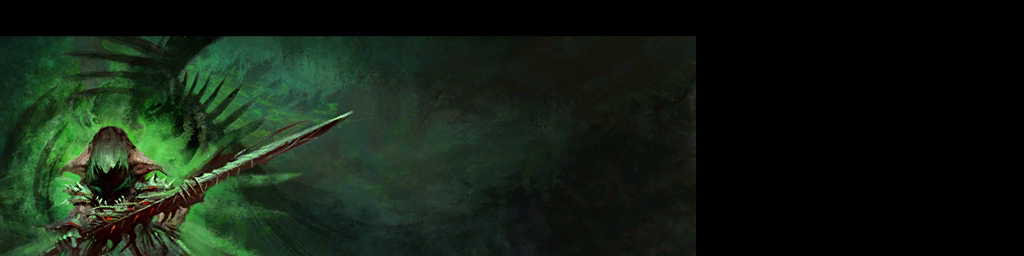
Reaper (Heart of Thorns) swaps Death Shroud for Reaper’s Shroud, built for melee, and adds shouts. This is the version where you wade into a crowd with an enormous scythe. The most straightforward of the four.
Scourge (Path of Fire) replaces the form with Desert Shroud and sand shades you place around the field. Instead of a personal shield you get a support zone for allies.
Harbinger (End of Dragons) brings Harbinger Shroud and stacks Blight, which lowers your maximum health in exchange for power. You deliberately trade durability for damage: the class that forgave everything starts to punish.
Ritualist (Visions of Eternity) replaces it with Ritualist’s Shroud and summons spirits.
Advice for a newcomer
Play the core class to 80 and take your time before an elite specialisation (why). Shroud needs to be felt: when to enter, when to leave, how much force to keep in reserve.
If melee appeals after 80, take Reaper. If being useful to a group appeals, take Scourge. Leave Harbinger for later: it removes the very cushion you picked a necromancer for.
The comparison against the other eight sits in the overview.
Questions people ask
Is necromancer good for beginners?
It is the most forgiving class in the game. Shroud acts as a second health bar, many skills heal you as they hit, and minions take some of the attention off you.
Which necromancer elite specialisation should I take first?
Reaper if you want melee, Scourge if you want to support a group. Leave Harbinger for later, because it trades away the survivability you picked the class for.
Why does light armour not make necromancer fragile?
Because it has the highest base health of the scholar classes and Shroud on top of that. Survival here comes from dodging and positioning rather than armour weight.